
How to choose the right cable gland
Density & flexibility in practice
The correct cable entry determines both tightness, flexibility and serviceability.
The choice is governed by how often you need to maintain the system, what IP requirements apply and whether the cables are routed with or without connectors.
Explore the right cable gland for tightness, flexibility, and serviceability.
Modular systems
(for cables with connector)
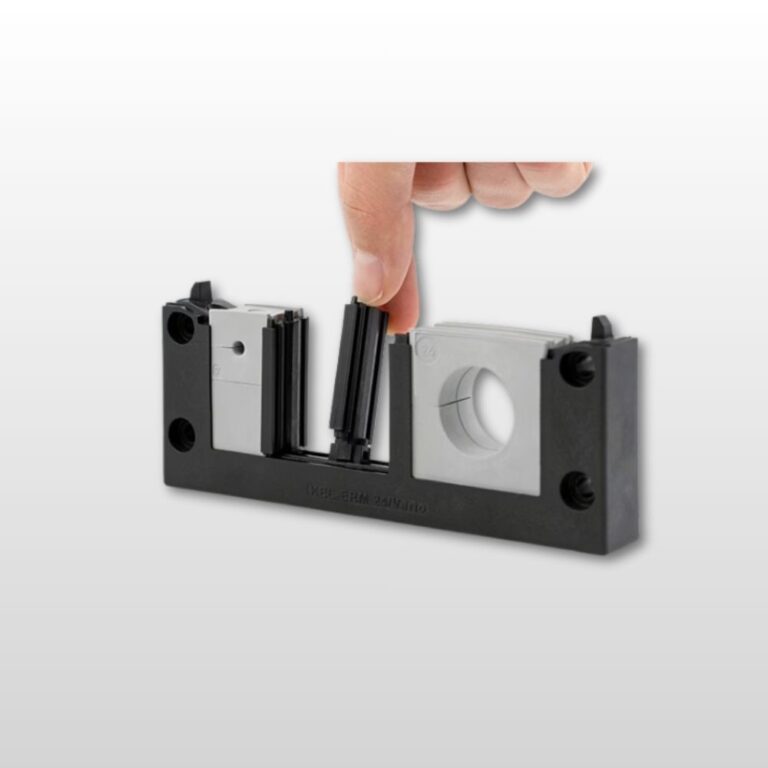
- IP class: IP54 – IP68
- For cables with connectors
- High flexibility & easy service
Typical applications include:
Machine builder, automation, energy
Cable entry system
for cables with connector
Cable entry plates
& Multi-flanges

- IP class: IP54 – IP68
- Too many cables without connectors
- High density & fast installation
Typical applications include:
panel builder, electrical cabinet
Cable gland plates
and multi-flanges →
Cable entry systems
with brush seal

- Flexible solution with brush sealing
- Low IP rating, simple & quick assembly
- For service panels & retrofitting
Typical applications include:
robotics, machine service panels
See cable glands
with brush seal
Which cable gland should I choose?
Cables with
finished contact
Modular systems
Many cables
without contact
Multi-fin
Frequent service
easy access
Brush seal
Maximum density
IP requirements
Modular or
multi-fly
Cost effective
solution
Brush seal
2. IP classes in practice
The IP rating determines how well a cable gland protects against dust and water.
Below is a comparison of the most common levels and their typical uses.
| IP class | Damn | Water | Typical uses |
|---|---|---|---|
| IP54 | Limited dust protection (dustproof) | Splash protection from all directions | Service panels, robotics |
| IP65 | Dammtät | Protection against water jets mouthpiece | Panel builder, control cabinet |
| IP66 | Dammtät | Protection against strong water jets | Industrial environments, outdoor installations |
| IP68 | Dammtät | Protection during submersion (long-lasting) | Demanding environments, outdoors with immersion |
2. Combined table overview
Different types of cable gland systems have their strengths and limitations.
Below we compare function, IP rating, advantages, and typical uses.
| Type | Cables with connectors? | IP class | Advantages | Limitations | Typical uses | Example (Icotek) |
|---|---|---|---|---|---|---|
| Modular systems | Yes | IP54 – IP68 | Contacts can pass, high flexibility, easy service and retrofitting | More expensive than simpler solutions | Machine builder, automation, energy | GOALKEEPER, GOALscorer |
| Plates & Multi-flanges | ✖ No | IP54 – IP68 | High density, easy and fast installation, many cables | Not designed for pre-made connectors | Panel builder, control cabinet | KEL-DPZ, KEL-DPU |
| Brush seal | Yes | Low IP rating | Flexible, low cost, service-friendly, easy retrofitting | Limited protection against dust and water | Robotics, service panels, machine service | KDR-BES-U |
FAQ – Frequently Asked Questions about Cable Gland
Which solution provides the highest density?
Modular cable entry systems and cable entry plates can achieve very high sealing classes, often up to IP66–IP68 depending on the model and installation. For installations with high requirements for dust and water protection, these solutions are usually the best choice.
Can cables with connectors be run through a multi-flange?
No. Cable glands and multi-flanges are intended for cables without fitted connectors. If the cables already have connectors, you will typically need to choose a modular cable entry system that allows you to pass the connectors without dismantling them.
When should I choose multi-flange over modular system?
A multi-flange connection is often the right choice when:
- The cables lack connectors
- Many cables will pass through the same opening
- High density is required
- Cost and ease of installation are prioritized
For pre-terminated cables, however, a modular system is often more suitable.
What IP rating is needed outdoors?
| Environment | Recommended IP rating |
|---|---|
| Indoor | IP54–IP55 |
| Industry | IP65 |
| Outside | IP65–IP66 |
| Demanding outdoor environment | IP66–IP68 |
Can cable glands be retrofitted?
What is the difference between KEL-U and KEL-ER?
KEL-U is a divisible cable entry system for cables with connectors, focusing on high density and ease of installation.
KEL-ER built on the same basic principle but also has an openable frame, making it even easier to retrofit or service cables in existing installations.
In short:
| Product | Advantage |
|---|---|
| KEL-U | Compact and dense solution for cables with connectors |
| KEL-ER | Openable frame for quick service and retrofitting |
KEL-ER is often chosen in machines and automation systems where cables regularly need to be replaced or supplemented.