
Timers and Counters
for industrial time control and pulse counting
Timers and counters are used to control, measure and monitor time, pulses and speeds in industrial systems.
They are central components in machine control, automation and production monitoring.
Explore our range of timers and counters
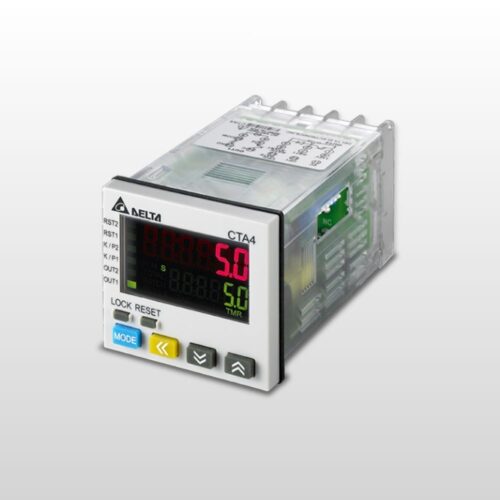
Multifunctional timers, counters and tachometers | for industrial applications
Technical characteristics of industrial timers and counters
- Combined functions: timer, counter and tachometer
- Support for pulse inputs from sensors and transducers
- Relay outputs for control
- Panel mounting for control cabinets
- Clear display for local reading
- Adapted for continuous industrial operation
(Detailed technical information can be found on the respective product page)
Related product areas
FAQ - Frequently asked questions about timers and counters
When are timers and counters the right choice?
Timers and counters are the right choice when control or monitoring is based on time, pulses or movements.
- Time control of machines, functions or sequences
- Pulse counting from transducers, sensors or machine components
- Speed measurement (tachometer function)
- Start/stop delays and time-delayed functions
- Monitoring of cycles, strokes or production steps
They are often used where simple, stable and stand-alone control logic is needed without complex PLC programming.
When might other solutions be more appropriate?
Timers and counters are intended for local and stand-alone time and pulse control. In some applications, other solutions may be more suitable.
- When all time and pulse control is already handled in the PLC or control system → separate timer or counter is not required
- For very complex logic or advanced sequence control → PLC or control system is more suitable
- When only simple indication is needed without control or logic → signal can be handled directly in existing system
In these cases, standalone timers and counters can provide unnecessary functionality.
How are timers and counters used in industrial systems?
Timers and counters are used as independent functional units in machines and automation solutions.
Common uses:
- Delayed start or stop of machines
- Counter for pulses, cycles or products
- Speed measurement of motors and shafts
- Timing of valves, signals or functions
- Production monitoring and simple statistics
What are time relays used for in industrial installations?
Timers are used to control functions based on time, such as delayed start, delayed stop or time-controlled sequences in machines and automation systems.
What are counters used for in industrial systems?
Counters are used to count pulses, cycles or events from sensors and actuators. For example, the number of strokes, products, revolutions or movements in a machine.
What is the difference between a timer and a counter?
A timer controls functions based on the passage of time, while a counter controls or monitors functions based on the number of pulses or events. Many industrial devices combine both functions in the same product.
When is the tachometer function used?
The tachometer function is used when speed or rotation speed is to be measured, for example on motors, shafts or conveyor belts. The function is based on pulses from a sensor and shows rotation speed in real time.
Can timers and counters be used without a PLC?
Yes. Timers and counters are often used as stand-alone devices when simple and stable control is required without burdening the PLC or building complex logic into the control system.
What types of signals can be counted?
Industrial counters can receive pulses from inductive sensors, optical sensors, mechanical contacts or other pulse encoders, for example. The exact signal type depends on the model.
When are timers and counters a better choice than PLC solutions?
For simpler time or pulse control where a dedicated function is sufficient, timers and counters can be a more cost-effective and reliable alternative than PLC-based control.