
Temperaturregulatorer
for industrial temperature control
Temperature controllers are used to measure, control and regulate temperature in industrial processes and control cabinets.
They are a central component in heating, cooling and process control in automation and industry.
Explore our range of temperature controllers
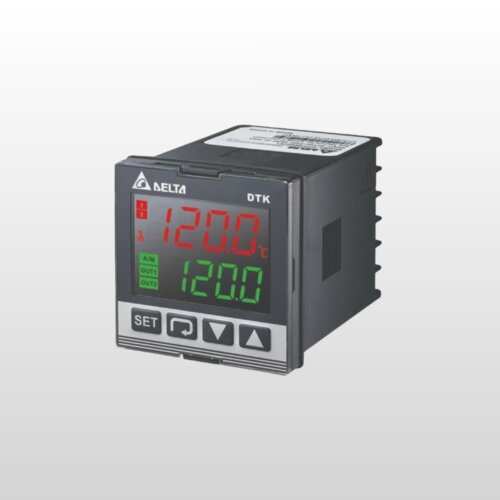
Compact PID temperature controllers | for precise temperature control in industrial applications
Technical characteristics of industrial temperature controllers
- Thermocouple support (K, J, T, E, N, R, S, etc.)
- Support for RTD sensors (Pt100, JPt100, etc.)
- PID control, ON/OFF control and manual control
- Panel mounting (e.g. 48×48 mm)
- Relay, pulse or analog outputs (model dependent)
- Auto-tuning and fast regulation
(Detailed technical information belongs at the product level)
Related product areas
FAQ – Frequently Asked Questions about temperature controllers
When are temperature controllers the right choice?
Temperature controllers are intended for active and accurate temperature control in industrial applications. However, in some cases, other solutions or existing functions may be more suitable.
- Temperature monitoring only without the need for active regulation → temperature values can instead be managed directly in the PLC or monitoring system
- Simple, low-precision heating applications → control can be done via simpler functions in heaters or fans with built-in regulation
- Applications where temperature control is already part of the machine's control system → separate temperature controller does not add any added value
In these situations, a standalone temperature controller can introduce unnecessary complexity.
When might other solutions be more appropriate?
Temperature controllers are intended for active and accurate temperature control in industrial applications. However, in some cases, other solutions or existing functions may be more suitable.
- Temperature monitoring only without the need for active regulation → temperature values can instead be managed directly in the PLC or monitoring system
- Simple, low-precision heating applications → control can be done via simpler functions in heaters or fans with built-in regulation
- Applications where temperature control is already part of the machine's control system → separate temperature controller does not add any added value
In these situations, a standalone temperature controller can introduce unnecessary complexity.
How are temperature controllers used in industrial systems?
Temperature controllers are used to control and regulate temperature in both processes and enclosures.
Common uses:
- Industrial heating furnaces and process heating
- Apparatus cabinets with requirements for temperature control
- Plastics, food and process industries
- Machines where temperature affects quality or safety
- Automation systems requiring precise temperature control
What are temperature controllers used for in industrial systems?
Temperature controllers are used to measure and actively control temperature in industrial processes, machines and control cabinets. They ensure stable operation, uniform temperature and protection of equipment.
What is the difference between PID control and ON/OFF control?
ON/OFF control turns heating or cooling on and off at a set value. PID control continuously adjusts the power and provides higher precision and more stable temperature.
Which temperature sensors are supported?
Temperature controllers typically support thermocouples (K, J, T, E, N, R, S, etc.) as well as RTD sensors such as Pt100 and JPt100. Exact sensor types depend on the model.
When should you choose a panel or DIN-mounted controller?
Panel-mounted controllers are used when local reading and manual setting via the front is important, for example in control cabinets or machines.
Can temperature controllers control both heating and cooling?
Yes, temperature controllers can be used to control both heating and cooling, depending on the application and configuration.
When is a thermostat sufficient instead of a temperature controller?
For simple applications without high precision requirements, a thermostat may be sufficient. Temperature controllers are used when precise and stable temperature control is required.